Our History
St. Martin’s History
St. Martin’s Episcopal Church in Ellisville was founded in 1965. Recognizing the potential growth of West St. Louis County, the Diocese of Missouri purchased four acres of land near the intersection of Clarkson and Clayton Roads (a soybean field at the time) for $27,000. Bishop George Cadigan called the Rev. Howard Park to be the founding vicar of a mission church for this fast-developing area.
Rev. Park began with five families willing to help him start this new mission: The Hebenstreit, Fialka, Joyce, Peters, and James families.
“I had decided that it took five families to start a church if they all agreed to teach Sunday School. That was one other thing about the area. Even though there were not all that many people here yet, the people who were, had plenty of children. With just the five families mentioned, we had 16 children between us,” Park recalled during a 1998 sermon.
“I knew we had to start not only worship services on Sunday, but also Sunday school and a youth group. Talk about faith. Every one of those adults agreed,” Park continued. “Education from the very beginning, along with worship, has been a core value of this church. And another is a dependence upon God’s blessings, first shown by 10 lay persons willing to do whatever it took to launch a church here in ‘suburban Kansas City.’”
Worship services and Sunday school began on September 19, 1965. The dedicated group rented space at Westridge Elementary School for their church.
With financial contributions from the Diocese and every church within the Diocese, as well as the people of St. Martin’s, the congregation broke ground on a new church building on the land along Clayton Road on August 25, 1967. On June 23, 1968, 35 families making up St. Martin’s moved into their new church building.
West County and St. Martin’s continued to grow during the 1970s. The missional church became self-supporting and was accepted as a full parish by the Diocese on March 20, 1977.
New worship and educational spaces were added to the facility in the 1980s. Additional priests and staff members were hired to serve the congregation. The parish continued to thrive under Howard Park’s leadership. He retired in July 1998, after 33 years of faithful service to St. Martin’s.
The Rev. Larry Hooper became the parish’s second rector in 2000, followed by the Rev. Jon Hall in 2010, and the Rev. Leslie Scoopmire in 2018. (Several interim priests served during each of those transitions.)
From the Youth Coffee Houses and massive Garage Sales of the past to the community garden and annual auto shows happening now, St. Martin’s serves as a strong and unified community, offering a warm welcome to all who venture in.
Learn more about the history of our parish in a booklet produced to celebrate the 50th anniversary of our church in 2015.
Download St. Martin’s History BookletSaint Martin, our patron saint
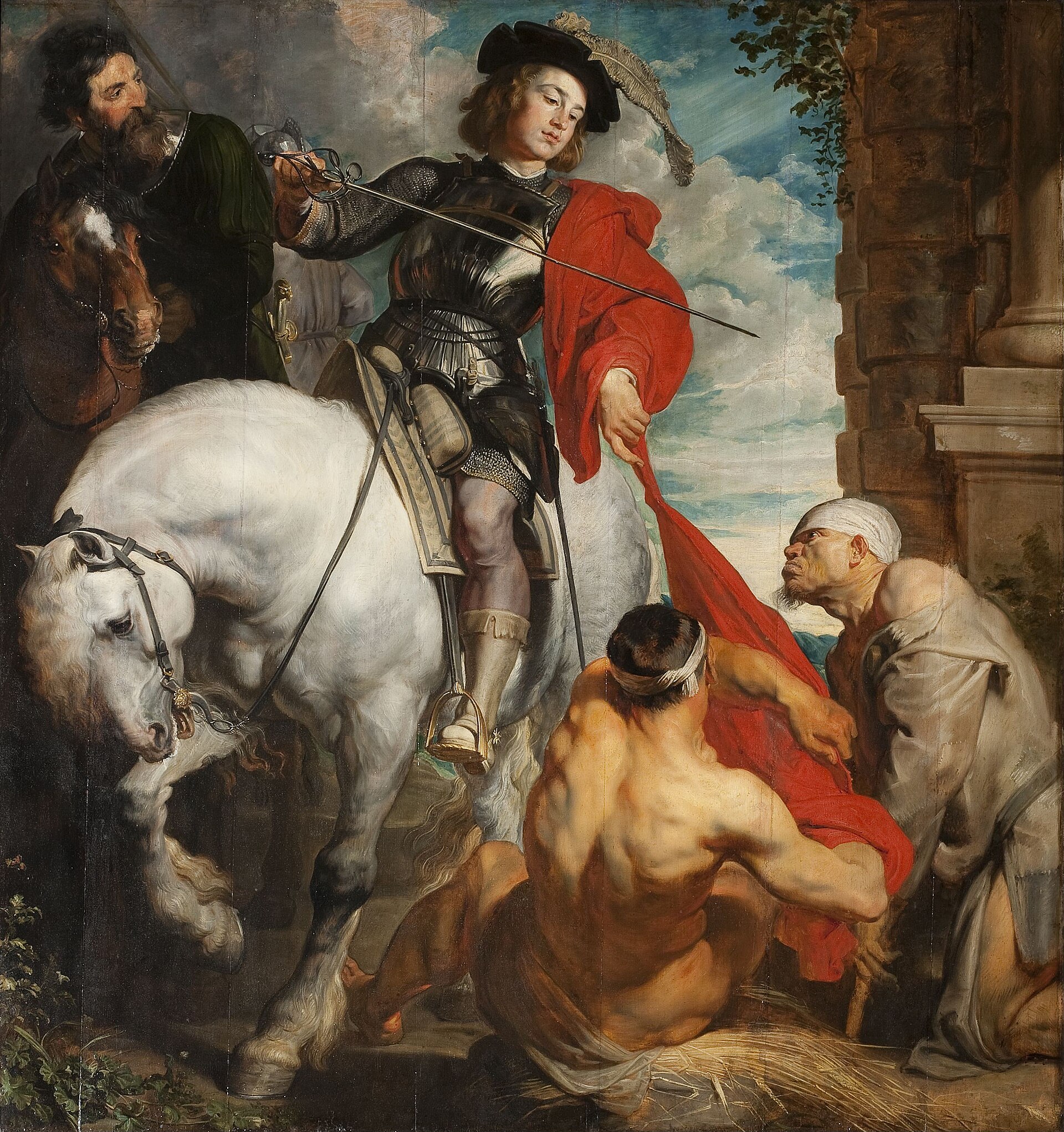
Saint Martin of Tours (c316-397 AD) was a conscientious objector to wars who was forced to serve as a Roman soldier.
One of the most famous stories about Saint Martin came from his time as a soldier when he encountered a scantily clad beggar in the depth of winter. According to the legend, Martin used his military sword to cut his cloak in two, and gave half to the beggar. Later, Martin dreamed of Jesus wearing the half-cloak which he had given away. In another version, he found his cloak restored to wholeness when he woke up.
Martin left the army and established what may have been the first French monastery near Poitiers, forming disciples and preaching throughout the countryside. In 371 he was acclaimed Bishop of Tours. It is said that Martin did not want to become a bishop and so he hid in a barn full of geese. The cackling of the geese gave him away and the rest is history.
We celebrate the Feast Day of Saint Martin on November 11.
According to the Rev. Howard Park, our congregation chose Saint Martin as a patron saint to symbolize our intention to meet the needs of people living in the growing West County neighborhoods on the outskirts of the large St. Louis metropolitan area.